After 25 years of building companies across three continents, and after becoming the midnight router of my own organization, I realized we were missing something fundamental: a way to measure how adaptive, fluid, and intelligent an organization actually is.
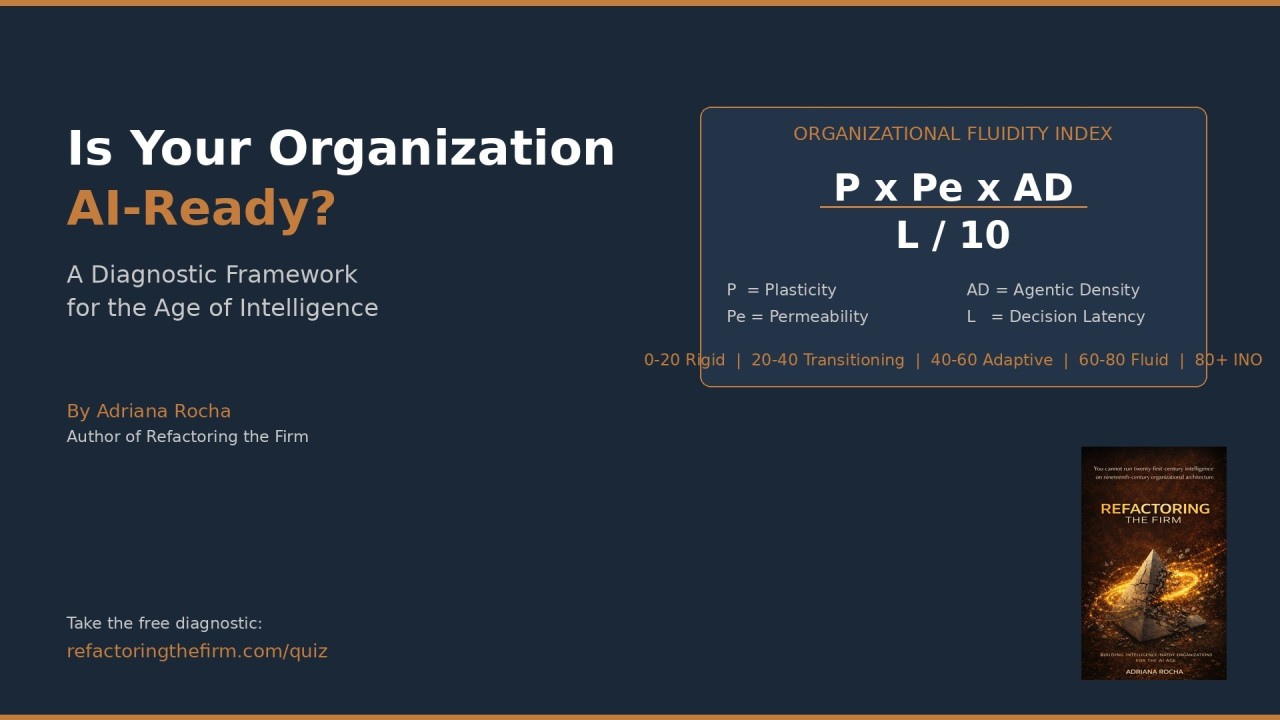
That realization led me to create the Organizational Fluidity Index (OFI).
THE PROBLEM: AI READINESS IS NOT AI ADOPTION
Most leaders confuse AI adoption with AI readiness. They are not the same thing. AI adoption means you have tools. AI readiness means your organizational architecture can actually absorb intelligence and coordinate it at scale. The gap between the two is where 88% of AI projects die.
THE FORMULA
OFI = (P x Pe x AD) / (L / 10)
Plasticity (P): How fast can your teams reconfigure around new work? When a critical deliverable arrives, does a squad form in 2 hours or 3 weeks?
Permeability (Pe): How freely does information cross organizational boundaries? Does a design insight in UX automatically reach engineering, or does it die in a silo?
Agentic Density (AD): What percentage of your work is genuinely augmented by AI? Not occasional ChatGPT use. Real, structural integration.
Decision Latency (L): The killer variable. How many hours from “a decision needs to be made” to “a decision is made”? This is the drag coefficient of organizational bureaucracy.
WHAT THE SCORES MEAN
0-20: Rigid. Industrial-age hierarchy. AI is bolted on.
20-40: Transitioning. Some fluidity, but structural barriers remain.
40-60: Adaptive. Can reconfigure, but human-AI integration is limited.
60-80: Fluid. Dynamic teams, good information flow, meaningful AI augmentation.
80+: Intelligence-Native. Continuous flow of human and machine intelligence.
Most traditional organizations score between 5 and 15.
TAKE THE FREE DIAGNOSTIC
I turned this into a free 3-minute quiz: https://refactoringthefirm.com/quiz
The OFI is one component of a larger framework I call the Intelligence-Native Organization, documented in my book Refactoring the Firm. The book covers the INO Stack, Digital Twins, Team Contracts, Squads, and a migration methodology for transitioning without disruption.
Drop your score in the comments. The organizations of the future will be designed, not managed. The diagnostic starts now.